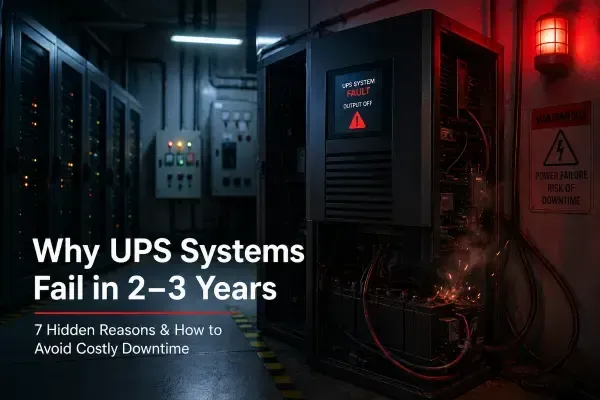
Why Most UPS Systems Fail in 2–3 Years (7 Hidden Reasons & How to Avoid Costly Downtime)
Most UPS systems don’t fail suddenly.
They fail silently.
At first, everything seems fine. Then:
Backup time reduces
Batteries weaken
Unexpected shutdowns begin
And by the time the issue is visible, the damage is already done.
This is not rare. It’s predictable.
In this article, you’ll understand:
Why most UPS systems fail within 2–3 years
The hidden mistakes buyers make
How to ensure long-term reliability and continuity
1. Wrong Load Calculation (Biggest Mistake)
Most UPS failures begin at the planning stage.
Buyers usually calculate only the current load.
They ignore:
Future expansion
Peak load spikes
Hidden or indirect loads
This leads to system overload and constant stress on components.
Over time, this reduces both performance and lifespan.
What to do instead:
Always design for future capacity and peak load, not just current usage.
2. Brand-Based Buying Instead of Design-Based Decisions
A common assumption is:
“Better brand means better reliability.”
In reality, even a premium UPS will fail if the system design is weak.
Reliability depends on:
Proper sizing
Correct configuration
Real usage conditions
Not just the brand name.
What to do instead:
Focus on system design first. Brand comes later.
3. Poor Battery Management
The battery is the core of any UPS system.
But most systems fail early due to:
Overcharging
Deep discharging
Lack of monitoring
This reduces battery life from 4–5 years to as low as 2–3 years.
What to do instead:
Ensure proper charging logic and regular battery health checks.
4. Ignoring Environmental Conditions
UPS systems are sensitive to their surroundings.
Common issues include:
High temperatures
Poor ventilation
Dust accumulation
Improper installation environments lead to overheating and faster component failure.
What to do instead:
Install systems in clean, well-ventilated spaces with controlled temperature.
5. Lack of Preventive Maintenance
Many buyers treat UPS systems as “install and forget.”
This approach leads to:
Undetected minor issues
Sudden major failures
Reduced system efficiency
What to do instead:
Follow a preventive maintenance schedule with periodic inspections.
6. Poor Installation and Wiring
Even a well-designed system can fail due to poor execution.
Common problems include:
Loose connections
Improper earthing
Voltage instability
These issues directly impact system performance and safety.
What to do instead:
Ensure professional installation with proper wiring and grounding standards.
7. No Continuity Thinking
This is the biggest gap.
Most decisions are made at the product level:
“What UPS should we buy?”
But the real question should be:
“How do we ensure uninterrupted operations?”
A UPS system is not just a backup device.
It is part of your business continuity strategy.
The ABS Approach: A Better Way to Evaluate UPS Systems
To avoid early failure, evaluate every system using this simple framework:
Risk
What can fail? Where are the weak points?
Reliability
Can the system handle real-world conditions consistently?
Continuity
Will your operations continue without disruption?
This approach shifts the focus from product selection to long-term performance.
Quick Checklist Before You Finalise a UPS System
Proper load calculation (including future expansion)
Design-focused decision making
Effective battery management system
Suitable installation environment
Preventive maintenance plan
High-quality wiring and earthing
Conclusion: Don’t Buy a UPS System Blindly
Most UPS failures are not accidental.
They are the result of decisions made too early and too quickly.
If you are planning to install or upgrade a UPS system,
don’t start with the product.
Start with risk evaluation.
Before you finalise anything, review this detailed checklist:
Before You Finalise UPS System
It will help you:
Identify hidden risks
Avoid costly mistakes
Make a reliability-first decision
Because in the end,
the cost of failure is always higher than the cost of doing it right.