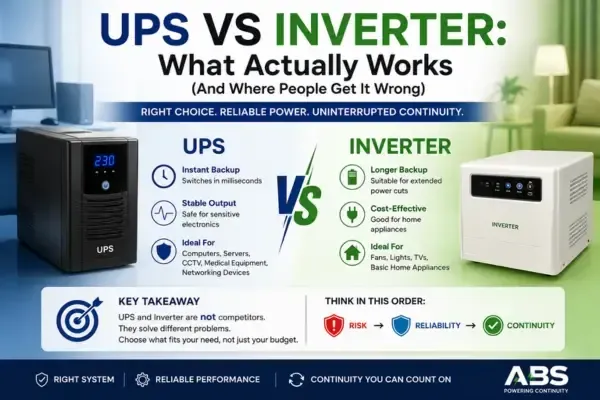
UPS vs Inverter: What Actually Works for Homes & Offices?
Power cuts are common.
But choosing the wrong backup system is even more common.
Most people compare:
Price
Brand
Backup time
And then ask:
👉 “UPS better hai ya inverter?”
The problem is:
That question is incomplete.
Because UPS and inverter are not competitors.
They are solutions for different needs.
And when the wrong system is chosen:
Performance suffers
Batteries fail early
Backup becomes inconsistent
Long-term cost increases
At ABS, we look at this differently:
Risk → Reliability → Continuity
That’s how better decisions are made.
🔴 RISK: Where Most People Go Wrong
The biggest mistake buyers make is comparing UPS and inverter like two versions of the same product.
They are not.
Each is designed to solve a different type of power problem.
Yet most buying decisions happen based on:
“Yeh sasta hai”
“Neighbour ne yeh lagwaya”
“Battery zyada backup degi”
This creates hidden risks later.
Mistake #1: Choosing Only on Backup Time
Many people assume:
👉 “Longer backup = better system”
Not always.
An inverter is usually designed for:
Longer backup duration
Home appliances
Fans, lights, TVs, basic loads
A UPS is designed for:
Instant backup
Sensitive electronics
Stable power delivery
That’s why computers, servers, medical equipment, and networking systems often rely on UPS systems instead of standard inverters.
Mistake #2: Ignoring Transfer Time
This is one of the most misunderstood areas.
When power fails, the backup system needs to switch from mains power to battery power.
This switching delay is called transfer time.
Typical inverter systems can take longer to switch compared to UPS systems. Some UPS systems switch within milliseconds, while online UPS systems provide near-zero transfer time for highly sensitive equipment.
Why does this matter?
Because even a small interruption can:
Restart computers
Interrupt internet/network devices
Cause data loss
Affect sensitive electronics
That’s why UPS systems are commonly preferred where continuity matters more than just backup duration.
Mistake #3: Buying a System That Doesn’t Match Usage
This happens everywhere.
Example:
A home needing long backup buys a UPS expecting several hours
An office running critical systems installs only a basic inverter
Both systems may technically “work”.
But performance remains compromised.
And that leads to:
Battery stress
Frequent complaints
Early replacement cycles
Ongoing adjustment
🟡 RELIABILITY: What Actually Works
Reliable power backup is not about buying the most expensive option.
It’s about choosing the right system for the right purpose.
When UPS Makes More Sense
UPS systems are usually the better choice when:
Equipment is sensitive
Power interruption cannot be tolerated
Stable output matters
Data protection is important
Examples:
Computers
Servers
Medical equipment
CCTV systems
Networking devices
UPS systems are designed to provide almost immediate backup power during outages.
When Inverter Makes More Sense
Inverters are often more suitable when:
Longer backup duration is required
Load mainly includes household appliances
Short switching delay is acceptable
Budget efficiency matters
Examples:
Fans
Lights
TVs
Basic home appliances
Inverters are commonly used for extended home backup applications.
The Real Difference Most Buyers Miss
This is not about:
❌ Which one is “better”
It’s about:
✅ Which one fits your actual requirement
Because:
Wrong UPS = unnecessary cost
Wrong inverter = unstable continuity
🟢 CONTINUITY: What You Actually Want
Most buyers think they are purchasing:
UPS
orInverter
But what they actually want is:
👉 Continuity
Systems that keep running
Stable backup during outages
No repeated battery issues
No constant adjustments
No unexpected downtime
That only happens when:
Risk is understood first
System is selected correctly
Usage is planned properly
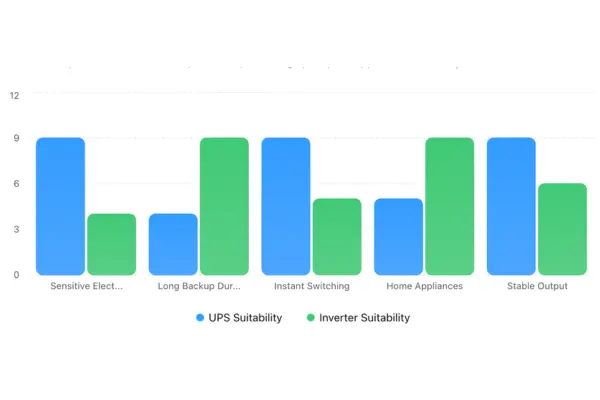
📊 Simple Comparison: UPS vs Inverter
UPS vs Inverter: What They Are Best Suited For
General comparison based on backup behavior, switching speed, and application suitability.
⚠️ Biggest Myth
“Warranty hai toh tension kya hai?”
Warranty does not guarantee:
Correct sizing
Correct application
Reliable long-term performance
A system can be under warranty
…and still perform poorly.
✅ Simple Checklist Before You Decide
Before choosing UPS or inverter, ask:
What devices am I running?
Do I need instant switching?
Is long backup more important than stable transfer?
What happens if power cuts for even 2 seconds?
Am I planning for today only—or future usage too?
If these answers are unclear,
the system choice will also remain unclear.
Need Help Choosing the Right Backup System?
Every home and business has different power requirements.
Choosing the wrong system can lead to:
- unnecessary cost
- unstable performance
- battery issues
- poor long-term continuity
At ABS, we help people make clearer backup decisions based on:
- actual load requirements
- usage pattern
- reliability needs
- future continuity
So you choose what actually fits your requirement — not just what gets sold most.
If you want guidance before finalising your power backup system, connect with ABS.
🟣 Final Thought
UPS vs inverter is not a product comparison.
It is a decision about:
Risk
Reliability
Continuity
The right system is not the one with:
Bigger battery
Bigger marketing
Bigger claims
It is the one that matches your actual need.
Because power backup is not just about electricity.
It’s about keeping your work, systems, and daily life running without interruption.
Read This Before You Finalise Any System
If you haven’t read our earlier guide yet, start here first:
Why UPS Systems Fail in 2–3 Years
It explains:
Why most systems fail early
Common sizing mistakes
What buyers usually overlook before purchase
Sources
UPS basics and transfer behavior
Custom HTML/CSS/JAVASCRIPT